

How Often Should You Change Engine Oil in Malaysia?
Published · Updated
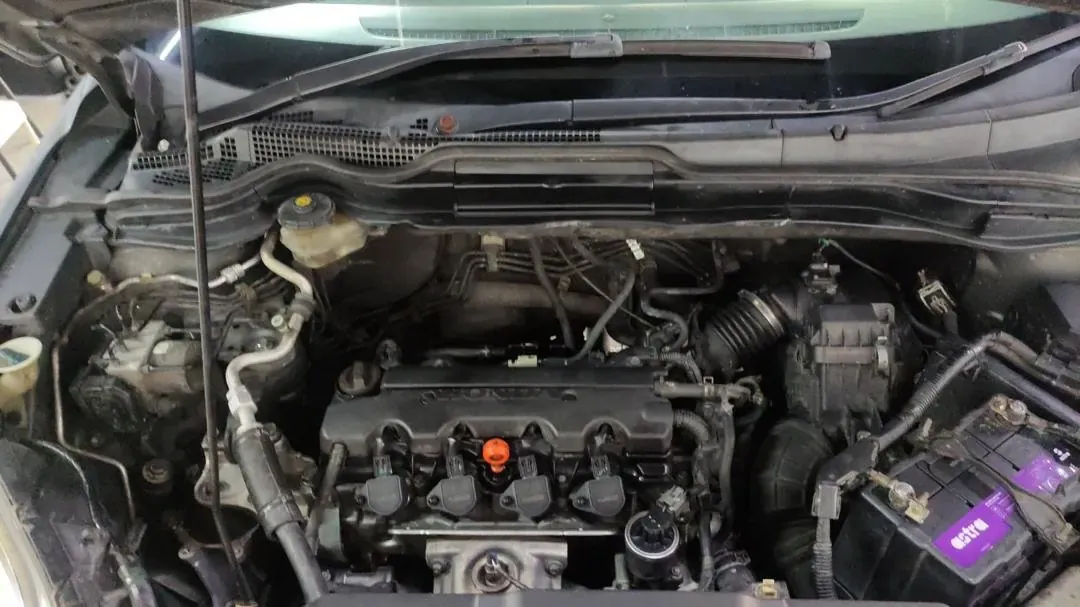
There is no single right number of kilometres. The correct interval for your car is the one in its owner's manual or service booklet: a distance and a time limit, whichever comes first, and often a shorter schedule for "severe" driving. Daily stop-go jams, short trips and long idling with the aircond on are exactly what many manuals class as severe, so a lot of Klang Valley drivers should be on that shorter schedule.
What engine oil actually does
Minyak hitam does more than keep metal parts from rubbing. It carries heat away from the pistons and bearings, holds soot and dirt in suspension so the filter can catch it, protects against corrosion and helps the piston rings seal. It does this with a base oil plus a package of additives: detergents, anti-wear agents, antioxidants.
Those additives get used up. Heat oxidises the oil, combustion by-products build up in it, and on short trips moisture and unburnt fuel can collect because the engine never gets fully hot. That is why oil wears out with time and driving conditions, not only with kilometres.
How often to change it: start with your manual
Distance or time, whichever comes first
Service booklets give two limits, such as a number of kilometres and a number of months. If you only drive 5,000 km a year, the time limit is the one that applies to you. Your service sticker or the reminder on the dashboard should show the next due date and mileage; if neither is there, the manual is the reference.
Normal schedule vs severe schedule
Many manuals print a second, shorter schedule for severe conditions. One example: a current Kia owner's manual lists frequent stop-and-go driving, repeated trips under 8 km, extensive idling or long low-speed driving, and heavy dust as severe use, and on that model shortens the oil change from 13,000 km or 12 months to 8,000 km or 6 months. Other brands use different numbers, so treat that as an illustration of how manuals work, not as the rule for your car.
In everyday Malaysian terms, severe use often looks like this:
- Peak-hour crawls on roads like the MRR2, Jalan Kuching or the Federal Highway, day after day.
- School runs and short errands where the engine barely warms up before it is switched off.
- Long idling with the aircond running, for example e-hailing or waiting in the car.
- Dusty roads and construction areas.
If most of your driving fits that list, follow the severe schedule. If you are unsure which applies, the shorter one is the safer choice.
Older engines and cars with an oil-life display
Some engines use or leak a little oil between services, and that tends to increase with age. On those cars the level matters as much as the interval, so check it more often rather than simply changing the oil sooner. Some newer cars show an oil-life percentage or service reminder that adjusts to how the car is driven. Follow it, and still check the dipstick.
Mineral, semi-synthetic or fully synthetic?
All three are sold in Malaysia, and the labels are less precise than they look. Castrol, for example, points out that there is no definition of how much synthetic base oil a "semi" or "part" synthetic has to contain.
| Type | What it is | Worth knowing |
|---|---|---|
| Mineral | Base oil refined from crude oil | Still specified for some older engines. Only use it where your manual allows it. |
| Semi-synthetic | A blend of mineral and synthetic base oils | The synthetic share varies by brand. Common middle option if the grade and spec match your manual. |
| Fully synthetic | Synthesised base oils with stronger molecules | Generally holds up better to heat and oxidation. Some newer engines are designed around thin synthetic grades. |
A better oil gives the engine more protection within the interval. It does not rewrite the interval. Oil makers sometimes advertise long drain intervals, but the carmaker's schedule is the one that applies to your engine and its warranty. Switching from semi to fully synthetic is fine as long as the new oil meets the grade and specification in your manual.
Reading the label: grade and specification
Viscosity grade, such as 5W-30
The number before the W describes how easily the oil flows when cold; the number after it describes its thickness at normal running temperature. The American Petroleum Institute's advice is simple: follow your vehicle manufacturer's recommendation on viscosity. Some manuals list more than one acceptable grade for different temperatures. Do not move to a thicker oil on the assumption that it protects better in hot weather; use what the engine was designed for.
Performance specification
The grade tells you thickness, not quality. Quality is shown by specifications on the back of the bottle:
- API service category for petrol engines: SQ is the newest, introduced in March 2025, and SP remains current. A newer category covers the older ones.
- ILSAC (the "starburst" symbol), used widely by Japanese and American carmakers. GF-7A is the current standard.
- ACEA sequences and carmaker approvals, which many European cars require. A bottle that only lists an API category may not meet them.
If the manual names a specification, the oil you use should list it.
Change the oil filter too
The filter traps the particles the oil carries away from the engine. As it clogs, a bypass valve lets oil flow around it so the engine is never starved, but that oil is no longer being filtered. Fitting fresh oil through an old filter wastes part of the benefit. Our oil service always includes a new filter, and it should be the right part for your engine, not just one that screws on.
How to check your oil level safely
- Park on level ground and switch the engine off. If you have just driven, wait 5–10 minutes so the oil drains back to the sump. A few manuals ask for the check with the engine warm, so read yours.
- Never reach into the engine bay with the engine running. Keep clear of the exhaust and radiator, which stay hot, and of the cooling fan, which on some cars can start by itself after the engine is off.
- Pull out the dipstick (usually a yellow or orange loop), wipe it clean, push it fully back in, then pull it out again and hold it level.
- The oil should sit between the MIN and MAX marks, ideally near the top. If it is low, add a little of the correct oil through the filler cap, wait a couple of minutes and check again.
- Do not overfill. Too much oil is also bad for the engine.
Some newer cars have no dipstick and show the level in a dashboard menu instead; the manual explains how. Check every few weeks and before a long trip, such as balik kampung.
What the oil looks like, and what it does not tell you
Modern oil turns dark soon after a change because the detergents hold dirt in suspension. Dark colour alone does not mean the oil is finished. More useful warning signs are a level that keeps dropping between checks, a milky or creamy look (possible water or coolant contamination), grit or metallic specks, or a strong smell of petrol. Any of those is worth getting inspected rather than just topped up.
Signs your oil service is overdue, or something else is wrong
- The service sticker date or mileage has passed, or the service reminder is on.
- The level is at or below the MIN mark.
- A ticking or tapping noise from the top of the engine, especially just after starting.
- A burning-oil smell after driving, often oil leaking onto the hot exhaust.
- Blue-grey smoke from the exhaust, which can mean the engine is burning oil.
- Fresh oil spots where you park.
These are symptoms, not a diagnosis. Noises and smoke have several possible causes; our guide to warning signs your car needs service covers the others.
What happens if you leave it too long
Going a few hundred kilometres past the due mileage once will not ruin an engine. Years of stretched intervals, running the level low, or ignoring the pressure light can. Worn-out oil thickens and forms sludge and varnish, which can restrict the small oil passages that feed the camshafts, bearings, timing chain and, on many engines, the variable valve timing. Repairing that kind of wear costs far more than routine oil services.
If your car is under warranty, the carmaker's warranty booklet sets out the maintenance you need to keep up and the records to keep. Wherever the work is done, keep receipts that show the date, mileage, oil grade and specification used.
What a proper oil service includes
- Draining the old oil, ideally while warm, and refitting the drain plug with a new washer where the engine uses one.
- A new oil filter suited to your engine.
- The correct grade, specification and quantity for your engine's capacity, then a level check after the engine has run.
- A check for leaks around the filter and drain plug.
- Resetting the service reminder and recording the date and mileage.
With the car on the lift it is also the easiest time to look at belts, hoses, coolant and brakes. At Otoka we inspect first and explain what we find before any paid work. You can see how the oil system fits into the engine on the Car Check engine view.
What an oil service costs
The price depends mainly on the oil: brand, grade, mineral or synthetic, and how many litres your engine takes. The filter and labour are the smaller part. Our quote estimator lists the Castrol oils we use at fixed prices together with the oil filter and service labour, so you can see a total before you book. If your manual calls for a grade that is not listed there, such as 0W-20, ask us on WhatsApp first so we can confirm what fits your car.
Common questions
Should I change my oil every 5,000 km in Malaysia?
Only if your manual, or its severe-conditions schedule, says so. A fixed 5,000 km habit can mean changing too early on a car that mostly cruises on highways, or too late on one whose manual sets a shorter time limit. Go by the manual and how you actually drive.
My car hardly moves. Do I still need an oil change?
Yes, at the time limit in the service schedule. Oil oxidises and collects moisture even with low mileage, and short trips are harder on it than long drives.
Can I top up with a different brand?
In a pinch, yes, as long as it is the same grade and meets the same specification. It is better than driving with the level low. Change to a full fill of the correct oil at the next service.
Sources
- American Petroleum Institute: API's Motor Oil Guide (2025)
- Castrol: The difference between conventional, synthetic, and semi-synthetic oil
- Kia owner's manual: Scheduled maintenance service (severe usage conditions)
- The AA: How to check and top up your car engine oil
- Castrol Singapore: How to check your engine oil
- Nissan owner's manual: Engine oil pressure warning light